Showing posts with label Peter Enns. Show all posts

Sunday, September 14, 2014

Evolving

That's a loaded term in some circles, I know. For many years, evolution, along with creation and the origins of things was something that concerned me greatly. My first thoughts regarding such things came about in second grade. I'd obviously, either in school or television, learned about dinosaur fossils and couldn't reconcile that knowledge with the creation stories in Genesis. I searched in earnest in my teens and twenties, then came children and other theological issues, so I gave it a rest, not believing in a strict six day creation, but still trying to figure out what place scripture held and how to interpret them.

The faith tradition I grew up in basically revolved around the Bible and the doctrines that tradition had developed around it. It became a law book and proof text, so that is how I understood the Bible. I'm very grateful for the teaching I received, particularly in my Sunday school classes at the Blue Starr Church of Christ. Unfortunately, regarding the Bible as a law book meant missing really important things, such as Jesus and all he means. It's not that Jesus wasn't important, but he wasn't as important as having the right doctrines and understanding. That makes for a weak saviour, not an all powerful one. I realize now that the faith translated to me was a form of gnosticism. Certainly this wasn't intentional, but as with all things, we humans skew what is meant for good.

So now, at the older age I am, I have experienced the Christian life in communities of the Church of Christ, Episcopalian, Anglican, Lutheran, and now Church of the Brethren, and I've learned good things from them all. One might think I'm simply fickle, and there may be a bit to that, though in fact there have been times I've probably stayed too long in a faith community to ensure that wasn't part of my motivation. I actually have to experience a lot of pain to make so significant a move.

As is probably obvious, my views of both scripture and the church have changed, or to use the loaded term, evolved. It's been an incredible process and I imagine it will continue to be, though at times it has been quite painful and frightening. What I hope is to fiercely hold to what is true without belittling what I have reached past and without fearing what may come.  Peter Enns posted a meditation by Richard Rohr not long ago. In it he says:
You have to learn from each stage, and yet you can’t completely throw out previous stages, as most people unfortunately do. In fact, a fully mature person appropriately draws upon all earlier stages. “Transcend and include” is Ken Wilber’s clever aphorism here. Most people immensely overreact against their earlier stages of development, and earlier stages of history, instead of still honoring them and making use of them (e.g. liberal, educated Christians who would be humiliated to join in an enthusiastic “Jesus song” with their Evangelical brothers and sisters even though they would intellectually claim to believe in Jesus, or adults who can no longer play, or rational people who completely dismiss the good of the non-rational).
 The journey is continuing. In fact, my Sunday school class will be reading Scot McKnight's book, The Blue Parakeet, and a theological reading group I'm part of will be reading Peter Enn's new book, The Bible Tells Me So. It will be interesting to see where this may lead, especially now that I'm no longer afraid, (at least not much), because my faith is in the one faithful one, and not my own understanding of him.

Saturday, February 16, 2013

Thought Mash Up

Sometimes I have so many ideas and thoughts, it's difficult to sit down and write about them, so I've decided to just write a bit of stream of consciousness for now. Perhaps later I'll write more on some of them.

At this time our family does not have a home congregation. While this leaves me feeling a bit unmoored, it also feels incredibly freeing. I'm sure this is not how others think I'm supposed to feel, and I'm pretty sure that when we do settle in somewhere I'll feel even better, but right now I'm enjoying not dealing with church politics, doctrinal differences, discrepencies between orthodoxy and orthopraxy, etc.

I've come to really question how we express the body of Christ, particularly the U.S. We set up heirarchies like governments or businesses, ignoring that Jesus said,  “The kings of the Gentiles lord it over them; and those who exercise authority over them call themselves Benefactors. But you are not to be like that. Instead, the greatest among you should be like the youngest, and the one who rules like the one who serves.". And we wonder why the church is innefective. More and more, I think the church should leave the buildings and organizations behind and meet in homes or community rooms at the local library, share a meal, pray, sing, study, help those inside and outside the church in a way that makes sense for the community. Yes, community is an overused word these days, but sometimes it fits.

I find proverbs annoying. They are so contradictory and they remind me of Mary Bennet.

I am thankful for N.T. Wright, Peter Enns, Christian Smith and many others who are helping a new generation gain a better understanding of the Bible and how to read it. It has been quite liberating to know that others are wanting to understand it in a way that makes sense and honors it, even if it means we have to let go of our pet ways of interpretation, because we really do make it impossible.

This week I read a post about how doing things a little bit everyday can help one make great progress over time and a review of a book that says the best things and people are the ones that can handle and do things in extreme. Both ring true and their contradiction is annoying in the same way that proverbs are.

As I've written before, C.S. Lewis in, The Abolition of Man, talks about applied science, or as is called in our times, technology, as dangerous in that it gives humans control over nature which leads to control over others and even future generations. This has been on my mind a lot as I've learned more about GMO's and industrial agriculture in general. I'm more and more convinced that we are making our land, animals and ourselves sick, though mask it through modern drugs. When I consider how we are to be stewards of creation I don't understand why more Christians do not speak out on this subject. 

On the positive side, I'm very grateful for the internet with its access to information and the freedom and choice this gives. Really, no one in the West has the excuse of ignorance any longer. What is called a low information voter is really either a misinformed voter or a lazy one. For me it has been helpful in figuring out some health issues and being able to treat them with diet, which I'm convinced is the remedy for most Western ailments. A website I've found helpful in this arena is The Perfect Health Diet. The Jaminet's have also written a book by the same title.

I find the teaching of Jesus on non-violence very difficult and compelling. Of course he has shown us by his life, death, and resurrection what non-violence looks like. Why do we not take this more seriously?

Sometimes I want understanding and harmony so badly it aches. To find the intersection of truth, goodness, and beauty seems to be my heart's longing. There are days when this desire is particularly palpable to me, and then I need to do the laundry, take Emma to ballet, help Olivia with her math. It is said that Lewis's sense of longing faded when he became a Christian. I'm not sure if this means I've weak faith, am a poor Christian or am just wired differently. Probably it's all three. What I do know is I love those longings. It is such a part of who I am, and I can't help but think that when I see Jesus, they will be fulfilled.

Wednesday, April 18, 2012

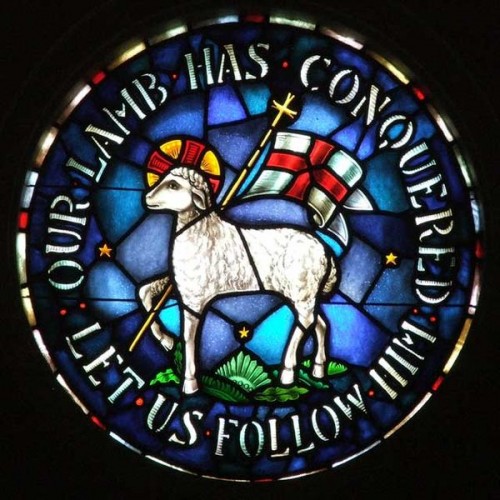
Lamb Of God

Lately, I've been thinking more about Jesus, his life, his meaning, his purpose, and the image of the Lamb of God continues to come forth in my mind. It is challenging to realize that God in Christ is portrayed as both shepherd and lamb. The one who guards and protects is also the one who is vulnerable and sacrifices.

I recently read that the Orthodox have an understanding of Jesus as Lamb before the foundations of the world. I think they are right. We in the western church have this idea that because we messed up, that God humbled himself to save us, but really, what we see in Christ is that God's nature is humble, serving, and sacrificing. That is true power, that is true love. This is what Jesus taught.

Peter Enns has a thought provoking post on just how hard it is to follow Jesus and to live as he taught. I think we find it difficult for a couple of reasons. One is that our faith is weak, which is another way of saying we cling to our idols. Another reason is that it doesn't make sense to us. We continue to think like the world thinks, ignoring how Jesus took on the form of a servant while also telling his disciples, "If you have seen me, you have seen the Father". The implications are huge, and I think when we finally understand that Christ lived kenotically, not as a fluke or suspension from his nature, but in expressing God's nature, we will better understand that we are called to do the same and in doing so, be transformed into his likeness. How else is what we are called to be even possible?

Below are two songs that relate to Christ as both shepherd and lamb. The first is Howard Goodall's setting of Psalm 23, which I've posted before. The other is a version of Agnus Dei, which is to me the most meaningful part of our worship, before receiving Christ himself. Both express the nature of the one who gives life, our protector and redeemer.