Showing posts with label Beauty. Show all posts

Friday, December 24, 2010

The Pain And Hope Of Beauty

There is an ache or sometimes even a stabbing pain felt when I encounter beauty.  From what I've read of the poets, and others who write of these things, this is not an odd occurrence, but rather, I think, a common one.  It is as if something or someone wonderful has been lost and there is a deep longing to be reunited.  As a Christian, this makes sense from the standpoint of the fall.  Humankind has lost the deep unencumbered communion with God, and so we are reminded of the depth of this loss when we experience this aspect of him reflected in his creation.  Most of our lives are spent in the mundane, doing what needs to be done to get on with life, over and over again.  This is not a bad thing, but there is a sense that there is so much more.  As Lewis said,
We do not want merely to see beauty, though, God knows, even that is bounty enough. We want something else which can hardly be put into words — to be united with the beauty we see, to pass into it, to receive it into ourselves, to bathe in it, to become part of it.
I've been thinking of this as we come near to Christmas.  How Jesus arrived in the mundane, giving up the glory that was inherently his.  We like to doctor up the story, either in the direction of the ethereal, almost otherworldly birth with no pain and Mary serenely looking over baby Jesus all beautiful, neat and clean with light emanating from their faces, or in telling that he was born in a barn with animals and mayhem all around, along with a nasty innkeeper who wouldn't give Mary and Joseph a room for the night.

The facts are just a bit too boring and mundane for our desires.  Mary and Joseph were probably staying in a relative's home in the lower level where the stores and animals would have been kept.  (The Greek word translated 'inn' in Luke 2 can also be translated 'upper room') We know there is a manger from the Gospel of Luke, but we don't know if there were any animals around.  We don't know how long they were there before Mary gave birth, though the story is often portrayed in our movies and books that they made it to the 'stable' just in time.

God has chosen largely to work in the mundane.  Jesus came into this world, like many babies before and after, in a house with two parents who loved him.  Mary and Joseph were working out their life in the context of their faith and vocation in the culture in which they were born, just as we do with our lives.  In the midst of all of this are sometimes signs, such as the beauty of a piece of music, or a dream with a message, but signs are pointers.  They point us to the one who has returned to glory and splendour, even as he is preparing us to enter such a state.
1 John 3:2
Beloved, we are God’s children now, and what we will be has not yet appeared; but we know that when he appears we shall be like him, because we shall see him as he is.

Tuesday, December 21, 2010

Have You Been Shocked?

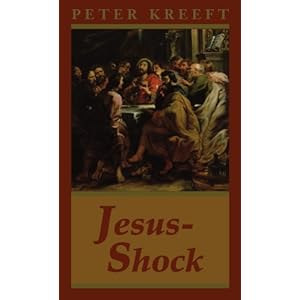
Here is a lecture by one of my favourite living philosophers and authors, Peter Kreeft, given at Saddleback Church.  His lecture is taken mostly from his book, Jesus Shock, though he leaves out the most Roman Catholic elements of the book, he engages the ideas that both Evangelical Protestants and Roman Catholics can agree upon, namely, that meeting Jesus will change you and your world.  He is not neutral, he is not safe, but he is good, true and beautiful.

There's a great deal of  'housekeeping' at the start of the video, so if you just want the lecture, begin at minute 16:00.

H/T Scot McKnight.

Tuesday, June 29, 2010

Do You Follow Fashion?

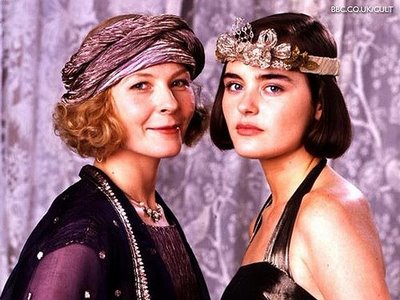
I don't.  It's not that I haven't tried, it's just that I don't get it.  I remember as a teenager, being really perplexed by not being able to put together an outfit like everyone else did.  There were always discrepencies between what was in the fashion magazines and what people really wore.  For a while I stuck with jeans and sweaters because it was ultimately safe.   How I found what I really liked was by watching movies and television.  I fell in love with the fashions worn in Chariot's of Fire, the Giorgio Armani clothing that adorned the fashion models shown on Style with Elsa Klensch,  many of the outfits worn by Lisa Bonet on The Cosby Show, and later the fashions on the BBC series, House of Eliott.

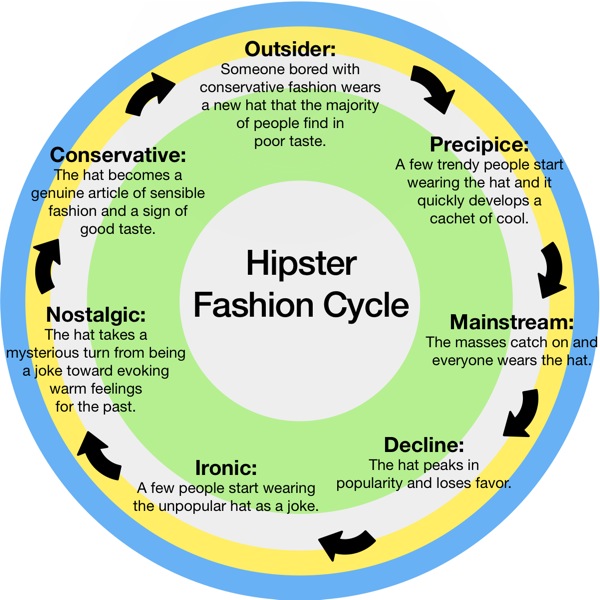
This led to a certain freedom in how I dress.  As my eldest daughter, Emma,  tells me, "Mom, you have a style, it's just not in style!".  Well, that suits me just fine.  What got me thinking about all of this,  is this graphic that Hipster Christianity sent out on Facebook.  My suggestion would be to skip the cycle and wear what you find to be beautiful and useful.  If you happen to land on the cycle every once in a while, no worries.  Life is too short to be concerned with being too hip or not hip enough.

Thursday, May 20, 2010

For Ascension Sunday

this is what we sang in choir.

I love this song both for its beauty and meaning.  It is one of my favourite chorale pieces to sing.  It was written by Thomas Tallis, an English composer, during the reign of Edward VI.    The words are taken from The Gospel of John 14:15-17
15If ye love me, keep my commandments.
16And I will pray the Father, and he shall give you another Comforter, that he may abide with you for ever;
17Even the Spirit of truth; whom the world cannot receive, because it seeth him not, neither knoweth him: but ye know him; for he dwelleth with you, and shall be in you.
 What a wonderful promise.

Friday, May 14, 2010

The Toymaker


For those who like art or have children who like paper crafts and to make their own toys, here is a wonderful website called The Toymaker.  These are really beautiful and there are even templates for boxes to use for gifts.  If you sign up for their newsletter, you'll be sent fun toys to make every month.  Lovely watercolors.

Wednesday, April 28, 2010

Boxen

Today I purchased C.S. Lewis' book, Boxen, which he wrote with his elder brother Warnie when they were children. Normally, I would have put off the splurge, and in fact this book is in my 'to buy' list at Amazon, but there it was in real, tangible life, and I didn't resist. I didn't even try.

Lewis' childhood literary influences were E. Nesbitt, Arthur Conan Doyle and Mark Twain, but his most loved was Beatrix Potter, where he found beauty.

He writes of how he began writing in Surprised by Joy:
What drove me to write was the extreme manual clumsiness from which I have always suffered. I attribute it to a physical defect which my brother and I both inherit from our father; we have only one joint in the thumb....As a last resource, as a pis aller, I was driven to write stories instead; little dreaming to what a world of happiness I was being admitted. You can do more with a castle in a story than with the best cardboard castle that ever stood on a nursery table.
I soon staked out a claim to one of the attics and made it "my study." Pictures, of my won making or cut from the brightly coloured Christmas numbers of magazines, were nailed on the walls. There I kept my pen and inkpot and writing books and paintbox; and there

                                    What more felicity can fall to creature
                                    Than to enjoy delight with liberty?

Here my first stories were written, and illustrated, with enormous satisfaction. They were an attempt to combine my two chief literary pleasures-"dressed animals" and "knights in armour."


Saturday, April 17, 2010

Christianity And Culture: Living In The Image Of God Part 1

This is from a series on Christianity and culture which I developed and taught last summer.

What is culture?

Culture is all around us. It’s the books we read, the type of food we eat and how we produce it, the songs we sing and listen to, the clothes we wear, the entertainment in which we partake, educational institutions, the technology we use, governing systems, the economy, the philosophies we believe, religion and faith, the words we speak, not to mention art and architecture. None of these exist in a vacuum from the other, nor can we exist in a vacuum from culture.

Here are a few definitions of culture:

1. The totality of socially transmitted behaviour patterns, arts, beliefs, institutions, and other products of human work and thought.

2. The act of, or any labor or means employed for, training, disciplining, or refining the moral and intellectual nature of man; as, the culture of the mind.

3. Comes from the word cultivate. (Think of the garden in Genesis 2)

4. James Davison Hunter defines it as; “The power to name reality”. The idea behind this is that when we name something, it defines that something and determines how we think about that something.

Culture is important for it is the nature of our humanity to create and participate in culture because God creates and we are made in His image. It helps shape our thoughts, attractions, morals and behaviours, even as we help to shape it.  As Dorothy Day said, A good society is one that makes it easy to be good.

We can evaluate culture by asking if it corresponds to what is true, good and beautiful and whether it is being made or used to the glory of God or as a substitute for God.

Before we look any closer at culture, lets look at what it means to be human, and why it is important?  Let's begin at the beginning.

Genesis 1
1:1 In the beginning, God created the heavens and the earth. 2 The earth was without form and void, and darkness was over the face of the deep. And the Spirit of God was hovering over the face of the waters.
3 And God said, “Let there be light,” and there was light. 4 And God saw that the light was good. And God separated the light from the darkness. 5 God called the light Day, and the darkness he called Night. And there was evening and there was morning, the first day.
6 And God said, “Let there be an expanse  in the midst of the waters, and let it separate the waters from the waters.” 7 And God made  the expanse and separated the waters that were under the expanse from the waters that were above the expanse. And it was so. 8 And God called the expanse Heaven.  And there was evening and there was morning, the second day.
9 And God said, “Let the waters under the heavens be gathered together into one place, and let the dry land appear.” And it was so. 10 God called the dry land Earth,  and the waters that were gathered together he called Seas. And God saw that it was good.
11 And God said, “Let the earth sprout vegetation, plants  yielding seed, and fruit trees bearing fruit in which is their seed, each according to its kind, on the earth.” And it was so. 12 The earth brought forth vegetation, plants yielding seed according to their own kinds, and trees bearing fruit in which is their seed, each according to its kind. And God saw that it was good. 13 And there was evening and there was morning, the third day.
14 And God said, “Let there be lights in the expanse of the heavens to separate the day from the night. And let them be for signs and for seasons,  and for days and years, 15 and let them be lights in the expanse of the heavens to give light upon the earth.” And it was so. 16 And God made the two great lights—the greater light to rule the day and the lesser light to rule the night—and the stars. 17 And God set them in the expanse of the heavens to give light on the earth, 18 to rule over the day and over the night, and to separate the light from the darkness. And God saw that it was good. 19 And there was evening and there was morning, the fourth day.
20 And God said, “Let the waters swarm with swarms of living creatures, and let birds  fly above the earth across the expanse of the heavens.” 21 So God created the great sea creatures and every living creature that moves, with which the waters swarm, according to their kinds, and every winged bird according to its kind. And God saw that it was good. 22 And God blessed them, saying, “Be fruitful and multiply and fill the waters in the seas, and let birds multiply on the earth.” 23 And there was evening and there was morning, the fifth day.
24 And God said, “Let the earth bring forth living creatures according to their kinds—livestock and creeping things and beasts of the earth according to their kinds.” And it was so. 25 And God made the beasts of the earth according to their kinds and the livestock according to their kinds, and everything that creeps on the ground according to its kind. And God saw that it was good.
26 Then God said, “Let us make man  in our image, after our likeness. And let them have dominion over the fish of the sea and over the birds of the heavens and over the livestock and over all the earth and over every creeping thing that creeps on the earth.”
27 So God created man in his own image,
in the image of God he created him;
male and female he created them.
28 And God blessed them. And God said to them, “Be fruitful and multiply and fill the earth and subdue it and have dominion over the fish of the sea and over the birds of the heavens and over every living thing that moves on the earth.” 29 And God said, “Behold, I have given you every plant yielding seed that is on the face of all the earth, and every tree with seed in its fruit. You shall have them for food. 30 And to every beast of the earth and to every bird of the heavens and to everything that creeps on the earth, everything that has the breath of life, I have given every green plant for food.” And it was so. 31 And God saw everything that he had made, and behold, it was very good. And there was evening and there was morning, the sixth day.
In Genesis 1: 1, 21, 27, the Hebrew word bara is used for create. It means to create something totally new, something which does not flow out of what came before and is only attributable to God. Bara is used three times in reference to man, underscoring his uniqueness.

In Genesis 1:26 we have the first hint of the Trinity. The complete Godhead was involved in the creation of man, adam (male and female).

We are made in the image and likeness of God. Imago Dei.  This is what it means to be human.

An image is a  material representation, as in a statue or on a coin, or a likeness or similarity, pattern, picture, semblance.  Humans are commanded to have no graven images because we are the icons/eikons.  To worship anything else leads us to become less than what we were made to be.

Note also, in Genesis 1:10,18,21and 25, God describes creation as good. In vs 31, after man has been created, God describes His creation as very good. 
As Augustine noted, whatever is, must be good. (God is the ultimate being, The Great I Am.) Thus, whatever loses it’s goodness loses it’s being. Whenever we fail to conform to the image of Christ we fail to become fully human.  We lose our I am-ness.

The significance of being made in the image of God is:

1. We are made to be in personal, obedient relationship with God.
2. We are made to be in personal, cooperative relationship with man.
3. We are given moral freedom
4. We have the ability to think, reason, communicate through language
5. We are given dominion over the earth, plants and animals.
6. We are to be fruitful and to recreate.

The consequences of the fall on our humanity are:

1. We are alienated from God, man being inclined toward idolatry.
2. Our relationships with fellow man is strained and inclined toward brokenness.
3. We no longer use our moral freedom rightly being inclined to sin.
4. We lose integrity. Reason, thought, communication are broken.
5. Ineffective dominion, often resorting to domination and misuse.
6. View children as burdens, sometimes less than human.

Adam and Eve turned from God, fearing Him and no longer trusting in His love for them. They then turned their focus and trust on themselves.  While still made in the image of God, now we are twisted, distorted and broken. Once created good, we now through the sin of adam, choose death over life, fear over love as explained in the epistle to the Romans.

Romans 1:21-25
21 For although they knew God, they did not honor him as God or give thanks to him, but they became futile in their thinking, and their foolish hearts were darkened. 22 Claiming to be wise, they became fools, 23 and exchanged the glory of the immortal God for images resembling mortal man and birds and animals and creeping things.
24 Therefore God gave them up in the lusts of their hearts to impurity, to the dishonoring of their bodies among themselves, 25 because they exchanged the truth about God for a lie and worshiped and served the creature rather than the Creator, who is blessed forever! Amen.
Here is a passage from, True Heroism in a World of Celebrity Counterfeits,  by Dick Keyes.  It helps to explain the true extent of not living in the image of God.
Sin is not only violating moral rules. It is described by the apostle Paul as falling “short of the glory of God” (Romans 3:23). Note that he does not say falling short of the “law” of God but of the “glory” of God–that is, short of the excellence of God in every area of his existence. It is certainly moral failure, but God’s moral excellence does not exhaust his nature. The seriousness of our sin is that we use our God-imaging capabilities to think, say and do things that oppose, defy and misrepresent God himself. As we misrepresent God’s image, we also misrepresent the selves we were created to be.
In Christ, however, the image is restored.  Christ emptied himself, kenosis, to make us like him.

Philippians 2:5-11
5 Have this mind among yourselves, which is yours in Christ Jesus,  6 who, though he was in the form of God, did not count equality with God a thing to be grasped, 7 but made himself nothing, taking the form of a servant,  being born in the likeness of men. 8 And being found in human form, he humbled himself by becoming obedient to the point of death, even death on a cross. 9 Therefore God has highly exalted him and bestowed on him the name that is above every name, 10 so that at the name of Jesus every knee should bow, in heaven and on earth and under the earth, 11 and every tongue confess that Jesus Christ is Lord, to the glory of God the Father.
See also, Romans 8:3-4

He is the true image of God.

Colossians 1:15-23
15 He is the image of the invisible God, the firstborn of all creation. 16 For by  him all things were created, in heaven and on earth, visible and invisible, whether thrones or dominions or rulers or authorities—all things were created through him and for him. 17 And he is before all things, and in him all things hold together. 18 And he is the head of the body, the church. He is the beginning, the firstborn from the dead, that in everything he might be preeminent. 19 For in him all the fullness of God was pleased to dwell, 20 and through him to reconcile to himself all things, whether on earth or in heaven, making peace by the blood of his cross.
21 And you, who once were alienated and hostile in mind, doing evil deeds, 22 he has now reconciled in his body of flesh by his death, in order to present you holy and blameless and above reproach before him, 23 if indeed you continue in the faith, stable and steadfast, not shifting from the hope of the gospel that you heard, which has been proclaimed in all creation  under heaven, and of which I, Paul, became a minister.
See also, II Corinthians 4:3-6

Christ transforms us into his image and restores creation.

Romans 8:12-30
12So then, brothers, we are debtors, not to the flesh, to live according to the flesh. 13For if you live according to the flesh you will die, but if by the Spirit you put to death the deeds of the body, you will live. 14For all who are led by the Spirit of God are sons of God. 15For you did not receive the spirit of slavery to fall back into fear, but you have received the Spirit of adoption as sons, by whom we cry, "Abba! Father!" 16 The Spirit himself bears witness with our spirit that we are children of God, 17and if children, then heirs—heirs of God and fellow heirs with Christ, provided we suffer with him in order that we may also be glorified with him.
 18For I consider that the sufferings of this present time are not worth comparing with the glory that is to be revealed to us. 19For the creation waits with eager longing for the revealing of the sons of God. 20For the creation was subjected to futility, not willingly, but because of him who subjected it, in hope 21that the creation itself will be set free from its bondage to corruption and obtain the freedom of the glory of the children of God. 22For we know that the whole creation has been groaning together in the pains of childbirth until now. 23And not only the creation, but we ourselves, who have the firstfruits of the Spirit, groan inwardly as we wait eagerly for adoption as sons, the redemption of our bodies. 24For in this hope we were saved. Now hope that is seen is not hope. For who hopes for what he sees? 25But if we hope for what we do not see, we wait for it with patience. 26Likewise the Spirit helps us in our weakness. For we do not know what to pray for as we ought, but the Spirit himself intercedes for us with groanings too deep for words. 27And he who searches hearts knows what is the mind of the Spirit, because the Spirit intercedes for the saints according to the will of God. 28And we know that for those who love God all things work together for good, for those who are called according to his purpose. 29For those whom he foreknew he also predestined to be conformed to the image of his Son, in order that he might be the firstborn among many brothers. 30And those whom he predestined he also called, and those whom he called he also justified, and those whom he justified he also glorified.

It is in Christ that we become truly human.

Monday, April 12, 2010

She Has Done A Beautiful Thing To Me

A few weeks ago I taught a Sunday school class while the scheduled teacher was out of town.  One of the passages of scripture I covered was Mark 14:3-9.
 3 And while he was at Bethany in the house of Simon the leper, as he was reclining at table, a woman came with an alabaster flask of ointment of pure nard, very costly, and she broke the flask and poured it over his head. 4There were some who said to themselves indignantly, "Why was the ointment wasted like that? 5For this ointment could have been sold for more than three hundred denarii and given to the poor." And they scolded her. 6But Jesus said, "Leave her alone. Why do you trouble her? She has done a beautiful thing to me. 7For you always have the poor with you, and whenever you want, you can do good for them. But you will not always have me. 8 She has done what she could; she has anointed my body beforehand for burial. 9And truly, I say to you, wherever the gospel is proclaimed in the whole world, what she has done will be told in memory of her."
 While I was preparing for the class, verse six caught my attention.  So many times  the emphasis is placed on how costly the nard was - a whole year's wages and how extravagant was the act.  One can easily begin to sympathize with the disciples for their consternation.  Notice though, Jesus says what she has done is beautiful.  One of the elements of beauty is proportion, to have harmonious relationships of parts within a whole, to have balance and symmetry.  In reality, in the Kingdom of God, what this woman did was not extravagant at all.  It was in perfect proportion, both in time and space, for she was preparing the Messiah's body for burial and anointing her king.  How carefully she must have listened to her rabbi!

Another aspect of beauty is that it points to the good and what is good points to what is true.  The Greek word used in verse six for beautiful is καλὸν, which means beautiful, commendable and good.  What the woman has done is not only in proportion, but is commendable, so much so that we continue to  praise her act to this day,  just as Jesus said we would.

I pray that God gives me a heart to see what is truly beautiful.

Thursday, March 11, 2010

The Morality Of Music

I continue to think about music and art, the objectiveness of beauty and how this affects the way we think and live.  See here, here and here for my previous thoughts on the matter.

Roger Scruton has written an article titled Soul Music.  In this piece, Scruton presents the idea that music itself, not just lyrics, carries with it morality.  He begins with referring to Plato's Republic, and then says this:
We know of music that is good-humoured, lascivious, gentle, bold, chaste, self-indulgent, sentimental, reserved, and generous: and all those words describe moral virtues and vices, which we are as little surprised to find in music as in human beings. Our ways of describing music give incontrovertible proof that we find moral significance in music—and it would be surprising if this were so and we did not also believe that people should be encouraged to listen to some things and discouraged from listening to others. For our characters are shaped by the company we keep, and those who rejoice in the company of crooks and creeps are likely to become crooks or creeps themselves. It is difficult, therefore, to disagree with Plato’s view that music has a central role in education, and that musical education can go badly wrong in ways that impact on the moral development and social responses of young people.
And even if we don’t forbid musical idioms by law, we should remember that people with musical tastes make our laws; and Plato may be right, even in relation to a modern democracy, that changes in musical culture go hand in hand with changes in the laws, since changes in the laws so often reflect pressures from culture. 
 He goes on to contrast music that triggers a response to music which provides a proper object of that response, natural and unnatural rhythms,( the latter which leads automatic and autonomous movements, dancing at rather than with), the melodic and amelodic.  There is much more to the article and I highly recommend it.

Perhaps we should be more thoughtful about art and music. Can we really expect to listen to music and not be changed in some way?  We have become very timid in our society about making judgments.  If music has a moral element, if it is soul and character shaping, we would be negligent in not evaluating it.

Sunday, January 31, 2010

Mending Broken Hearts

C.S. Lewis writes of grief feeling like fear in A Grief Observed. I have found this to be a very accurate description and there is the temptation to avoid it if possible. What I am learning is that once one accepts it, on the other side is a sadness, but it is a softened and almost sweet sadness.

I was thinking tonight that it is not just sorrows that break our hearts, but also being in the presence of great beauty or receiving an undeserved kindness. I think this must happen so that God can mend them back correctly.

How precious is your lovingkindness, O God! And the children of men take refuge in the shadow of your wings. Psalm 36:7

Monday, September 7, 2009

Into The Wardrobe


Tomorrow, we'll begin a new school year. As I had mentioned in an earlier post, we will take the next several months to focus on The Chronicles of Narnia and use these books as a jumping off point for other literature, history, theology and philosophy. We will begin with, The Lion, the Witch and the Wardrobe, while also focusing on Norse myths, The Gospel of Luke, the Blitz and Aesop's Fables. If you've read LWW, you'll see how these fit in.

I'll post more of what we're reading and of our discoveries as we progress.

Emma will continue to study Latin, math, Greek, writing, art, logic, classical astronomy, and ballet.

Olivia will study English, nature studies, math, Latin, basic astronomy, art, piano, and horseback riding.

In all of this, setting before us, the good, the true and the beautiful in order to cultivate wisdom and virtue.

Monday, August 24, 2009

Just Thinking


I didn't sleep well last night, so it may not be a good idea to write having so little rest, but here I go anyway.

What would life be like if we stopped concerning ourselves with what is practical, pragmatic or utilitarian, but rather concerned ourselves with what was true, good and beautiful? What would our lives look like? What would our relationships be like?

As I prepare the curriculum for my children this year, I find myself asking this question more and more. While homeschooling is wonderful, particularly in the choices and freedom it gives, there are limits - limits of time and resources. It is so easy to think too practically if the focus is on the limits, so I have to keep reminding myself to take the long view, and the ultimate goal, which is to help develop in my children a deep love and attraction for what is good and true and beautiful. In other words, a deep love for God, for after all, these are his attributes.

More thoughts later.

Monday, February 9, 2009

Is All Beauty Objective? Continued...

These posts on beauty began with me wondering why some are repelled by beauty and hypothesizing that it may be because it exposes the dreariness in some lives. (Dreariness that I believe could be relieved if one looked to where the beauty is pointing.) They have since focused on the question of whether beauty is objective, with Janine holding the view that some beauty is objective and other beauty is subjective. I maintain that beauty is objective because its source is God. I will try to explain better my thoughts, borrowing heavily from Edwards, Kreeft, and of course, Lewis.

Truth, goodness and beauty are the attributes of God, and therefore are objective. Truth is defined by being. God is. He is the great I AM. Goodness is defined by truth and right relation to truth. Beauty is defined by goodness, we recognize goodness by it's beauty.

When we are tempted to say that beauty is subjective, it is not really beauty that is subjective, but we ourselves that are subjective. We recognize beauty by our desires, or heart, we recognize goodness with our will and we recognize truth with our minds. We who are Christians understand that sin has corrupted our minds, wills and hearts, so when we are tempted to say that all or any of these attributes are relative or subjective, we know this cannot be true as these are attributes of God. We continue to see through a glass darkly because we are still being conformed to the likeness of Christ.

Jonathan Edwards speaks of beauty as the consent of being to being. He sees the beauty in the goodness of actively looking out for an other's welfare. He also sees this beauty reflected in what we understand as aesthetics - harmony, proportion, symmetry, et cetera.

I think Janine's discourse comes from the question of why we are attracted to different things. I think there are a few different reasons. One could simply be how our aesthetic sensibilities have been shaped. Someone raised on pop music and television may have different sensibilities than someone raised being taken to the symphony and theatre, or even of someone raised with fairy tales and simple folk music. Another may be sin. When one is attracted to pornography or drugs, it is a substitute for real beauty. As Anonymous wrote in the comments, it is a lie. The only way to break such an addiction is to exchange it for real beauty. There may also be some who experience different facets of beauty, differently. I recognize in myself this limitation when it comes to cheesecake. I understand that for most people it is a luxurious dessert, but I do not care for it. I see this as a flaw of my palate, not a flaw in the dessert itself. I can recognize the harmony and balance of the ingredients, yet I don't like it.

In his article , A Holy Longing, published in Christianity Today, David Taylor says,(referring to a list of beautiful things),

All these works are beautiful, though never merely subjectively. For in every case they reveal the objective pattern of unity, complexity, and richness, which collectively evoke longing. Differently for each of us, they stir an ache in our hearts. The longing for what? For starters, the longing for joy, for order, and for more beauty.


When we encounter beauty, it points to the All Beautiful, All Desirous. One day we will be united in beauty. As Lewis says in his sermon, The Weight of Glory,

At present we are on the outside of the world, the wrong side of the door. We discern the freshness and purity of morning, but they do not make us fresh and pure. We cannot mingle with the splendours we see. But all the leaves of the New Testament are rustling with the rumour that it will not always be so. Some day, God willing, we shall get in. When human souls have become as perfect in voluntary obedience as the inanimate creation is in its lifeless obedience, then they will put on its glory, or rather that greater glory of which Nature is only the first sketch.....

Monday, February 2, 2009

Truth, Goodness and Beauty

Peter Kreeft on Goodness, Truth and Beauty, with a good dose of Lewis.

Is All Beauty Objective? A Friendly Debate.

It appears that Janine and I have some fleshing out to do regarding the terms and meaning of beauty. I graciously accept her critique and present my defense. I also thank her for causing me think more deeply about the questions and thoughts I presented.

To begin, I believe beauty is objective, not subjective. When Janine speaks of the beauty of creation, I think she is quite correct. Where I think we may differ is in her assessment of everyone's reaction to it. Her belief that everyone's breath would be taken away shows how pure her spirit is, yet I don't think everyone's breath is taken away. There are those who would shun it, ignore it, be jealous of it, or fear it, which would explain why so many seem hellbent to destroy it. My question from my previous post is why this is? For those who followed the link and read the article to which I referred, why does Bach keep hooligans away from shops as well as ear piercing tones? Many's reaction would be attraction to the music, but that is obviously not a universal reaction. I think the problem in this instance is not with the music, but with the lives of the juvenile troublemakers. Why this repulsive reaction to such beauty?

I actually think Janine and I agree more than appears on the first reading of our posts. She sees what attracts us, mirrors our hearts, and I fully agree with that, though I would not say that a person views pornography because they see it as beautiful, but to feed a desire in a way God did not intend. My point is similar. Here is what I said in the post to which she responded. I may be wrong, but I have a suspicion that beauty takes us outside of ourselves to see the possibility of something greater, and that, in our current culture, makes us uncomfortable, because if what is reflected back exposes the dreariness of our lives, it is almost too much to bear. Is there not sometimes a similar reaction when someone is faced with an unwanted truth? Repulsion and denial?

Here is something to think about. For most of history, Judaism and Christianity thought of truth, goodness and beauty as objective. Isn't it interesting that all are now seen by the majority of the western world as subjective? If God is true, good and beautiful, then there must be an objective standard, and He is the standard. In the Garden of Eden, the fruit was eaten so that we could decide what was good and what was bad, and this appears to fully be our zeitgeist.

Friday, January 30, 2009

If Our Lives Are Ugly

can we accept beauty?

A portion from Theodore Dalrymple in City Journal:

Leys was sitting in a café where other customers were chatting, playing cards, or having a drink. The radio was on, tuned to a station that relayed idle chatter and banal popular music (you are lucky these days if popular music is banal only). But suddenly, and for no apparent reason, it played the first movement of Mozart’s clarinet quintet, transforming the café into what Leys called “the antechamber of paradise.” The customers stopped what they were doing, as if startled. Then one of them stood up, went over to the radio, and tuned it to another station, restoring the idle chatter and banal music.


There's a grocery store I frequent that plays orchestral or chamber music, most often Vivaldi, while all the others in town play some sort of pop music. There are both contemporary and traditional liturgical worship services at the church in which I belong. Why is there only one grocery store that will play Vivaldi and why are there more folks in attendance at the 11 AM contemporary worship than at the 11 AM liturgical service? Is it that beauty makes us stop? Is it that it refuses to stay in the background, or is it that one must pay attention when there isn't the constant rhythm of popular music?

I may be wrong, but I have a suspicion that beauty takes us outside of ourselves to see the possibility of something greater, and that, in our current culture, makes us uncomfortable, because if what is reflected back exposes the dreariness of our lives, it is almost too much to bear.

Below is Winter from Vivaldi's Four Seasons. My heart always aches from 2:17 - 4:33. Take time to listen.